
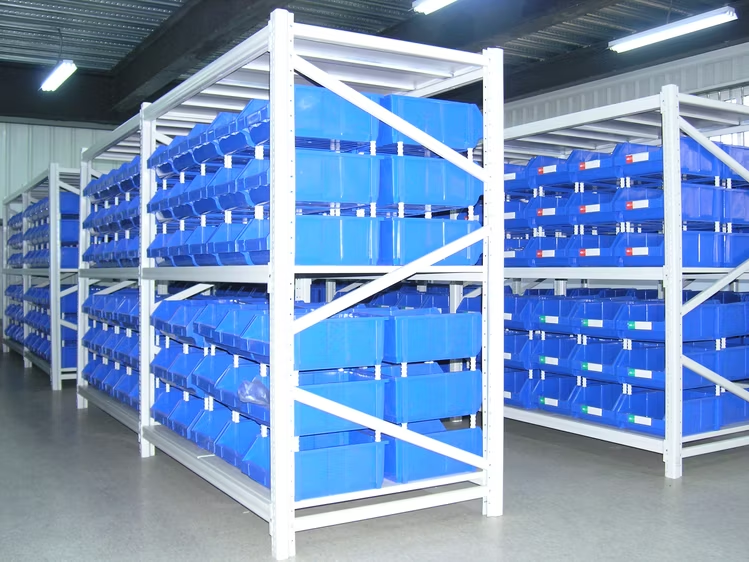
Industrial stackable storage boxes are, in the clearest sense, a response to a problem that every warehouse manager, logistics operator, and facilities director in Singapore knows intimately: there is never enough space. The relentless pressure to store more within fixed floor areas, to keep inventory accessible without sacrificing organisation, and to do all of this at a cost that does not erode operational margins, drives procurement decisions every day across the island’s industrial estates and distribution facilities. The industrial stackable storage box addresses that pressure directly, offering a storage solution that works vertically as effectively as it works horizontally. Understanding how, and why, requires a careful look at what these systems actually deliver.
What Industrial Stackable Storage Boxes Are Built to Do
At their core, industrial stackable storage boxes are rigid, load-bearing containers designed to be stacked securely on top of one another without structural compromise. Unlike standard storage bins or general-purpose crates, industrial-grade variants are engineered to withstand significant compressive loads, meaning the weight of multiple filled boxes can be stacked vertically without deforming or collapsing the units beneath.
The design typically incorporates interlocking rims or recessed bases that align each box precisely with the unit below, preventing lateral shifting during stacking and retrieval. This structural feature is not incidental. In a busy warehouse environment, where forklifts, pallet jacks, and workers move through aisles continuously, a stacked column of storage boxes that shifts or topples represents both an operational disruption and a genuine safety hazard. The interlocking geometry of quality industrial stackable storage boxes eliminates this risk by design.
The Space-Saving Case: Vertical Storage Done Right
Singapore’s industrial real estate is among the most expensive in the region. For businesses operating in logistics parks across Jurong, Tuas, and Ubi, every square metre of warehouse floor carries a cost that makes inefficient use of vertical space a measurable financial liability. This is where industrial stackable storage boxes deliver their most compelling value.
By enabling stable vertical stacking to heights of four, six, or even eight units, these boxes allow operators to multiply the effective storage capacity of a fixed floor footprint without structural modification to the facility. A floor area that previously accommodated two rows of single-layer bins can, with properly specified industrial stackable storage boxes, accommodate the same inventory volume in a fraction of the floor space.
The practical implications extend beyond raw capacity:
Improved aisle access
Consolidating inventory into taller, more compact stacks frees up aisle width, making it easier for forklifts and workers to navigate between storage zones safely and efficiently.
Clearer inventory organisation
Each industrial stackable storage box can be labelled, colour-coded, or fitted with document holders, allowing staff to identify contents without unstacking, which reduces handling time and minimises the risk of inventory errors.
Flexible reconfiguration
Unlike fixed racking systems, stacked boxes can be reorganised rapidly in response to changing inventory volumes or operational requirements, giving facilities managers a degree of adaptability that permanent infrastructure cannot provide.
Material Composition and Durability
The performance of industrial stackable storage boxes over time depends substantially on the materials from which they are made. In Singapore’s logistics and manufacturing sector, the dominant material of choice is high-density polyethylene, selected for a combination of properties that suit both the tropical climate and the demands of industrial use.
High-density polyethylene does not corrode, absorb moisture, or degrade under ultraviolet exposure. In Singapore’s persistently humid environment, these properties are not merely convenient. They are operationally necessary. Metal storage containers rust, wooden crates warp and splinter, and neither is easily sanitised to the standards required in food-grade or pharmaceutical storage environments. A well-manufactured industrial stackable storage box in high-density polyethylene resists all of these failure modes, maintaining its structural integrity and hygienic surface properties across years of demanding use.
Polypropylene variants offer additional chemical resistance, making them the preferred choice in industrial settings where containers may be exposed to oils, cleaning agents, or mild solvents during normal operations.
Load Ratings and Operational Specifications
Selecting the right industrial stackable storage boxes for a given application requires attention to load ratings, both for individual units and for stacked columns. Standard industrial models in Singapore are typically rated to carry between 25 and 50 kilogrammes per unit, with stacking load ratings specifying the maximum compressive force each box can sustain from units stacked above it.
Key specification considerations include:
Individual load capacity
Determines how much product each box can carry without base deformation, directly affecting how the box performs during transit and storage.
Stacking load rating
Specifies the maximum weight the box can bear when placed at the base of a vertical stack, a figure that should always be verified before configuring high stacks in a live warehouse environment.
Internal dimensions
Matching internal dimensions to the size and packaging format of stored products minimises wasted space within each box and ensures efficient use of the vertical stack.
Lid and closure options
Fully lidded industrial stackable storage boxes protect contents from dust and moisture, while open-top variants allow faster access and visual inventory checks during picking operations.
Applications Across Singapore’s Industrial Landscape
The versatility of industrial stackable storage boxes is evident in the range of sectors that rely on them. Manufacturing facilities use them to organise components and work-in-progress inventory along production lines. Food distribution operations use hygienic, lidded variants in cold storage environments where temperature and sanitation standards are tightly controlled. Pharmaceutical warehouses deploy them for the organised storage of packaged products that require clear traceability and minimal contamination risk. Retail distribution centres use colour-coded systems to segregate inventory by category, destination, or handling priority.
Across all of these environments, the underlying logic is consistent. Space is finite and expensive. Inventory must be accessible, organised, and protected. And handling equipment must support efficient movement without adding unnecessary complexity. Taken together, well-specified industrial stackable storage boxes meet all three requirements simultaneously.
