
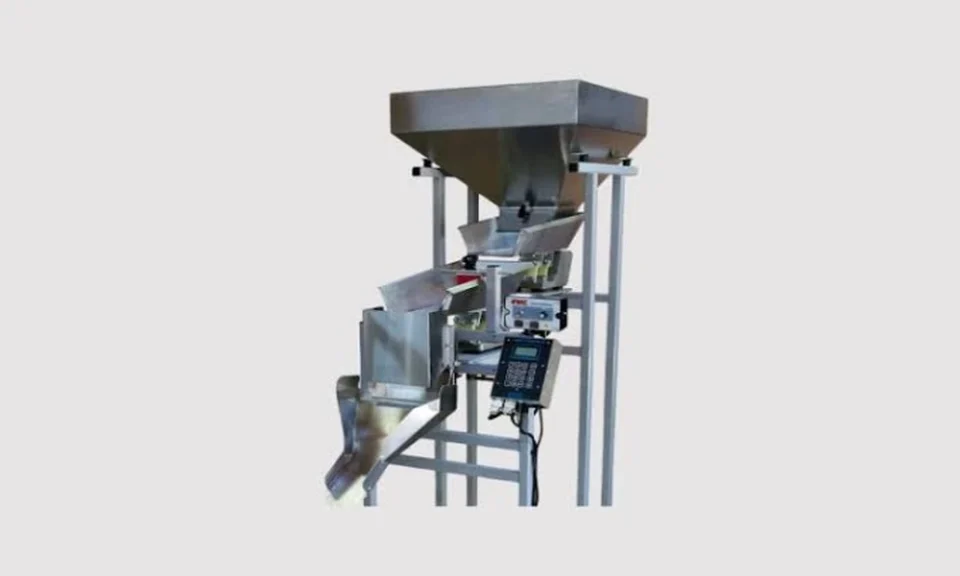
A single fill on a modern line is over in a few seconds, too quick to follow by eye. Slow it down and an automatic weighing and filling machine turns out to perform seven or eight distinct actions in that time, each one a small decision about accuracy. Understanding the sequence explains why two machines with similar specifications can deliver quite different results, and it gives a buyer better questions to ask than how many containers a minute.
Zero: The Container Lands
The cycle begins when an empty container arrives on the weighing platform, or under the nozzle if the weighing is done elsewhere. It has to stop dead and sit clear of guides and neighbouring containers, because anything touching it will carry part of its weight. Designers isolate the weigh platform from conveyor vibration for the same reason. A machine that weighs while the container is still rocking has lost accuracy before any product moves.
One: Taking the Tare
Next the controller reads the empty container and sets that value aside. Bottles and pails are never identical; a batch of plastic jerry cans can vary by several grams, steel drums by far more. Taring each one means the target applies to the contents alone. Machines that assume a fixed container weight are simpler and faster, and they quietly transfer every variation in the packaging into the amount of product the customer receives.
Two: The Fast Stage
The valve opens fully and product pours at the highest rate the liquid and container will tolerate without foaming or splashing. Most of the dose goes in during this stage. The load cell signal climbs steeply, and the controller filters it to ignore the thump of the liquid stream hitting the base. How well that filtering is tuned is one of the less visible differences between a good control system and a mediocre one.
Three: Changing Down
At a set point short of the target, the valve throttles to a fraction of its opening, or a second smaller valve takes over. Flow drops to a thin stream. Slowing down gives the scale time to see the weight as it truly is. Set this point too early and output suffers; too late and the fill overshoots. On well-designed machines the changeover point is part of the stored recipe for each product and container.
Four: Closing Early on Purpose
When the valve shuts, some liquid is still falling between nozzle and surface. The controller therefore closes slightly before the target and lets this in-flight material finish the job. Better systems measure the error on each fill and adjust the closing point for the next, correcting themselves as tank level or temperature shifts. Ask suppliers of inline weight and volumetric fillers whether their controller does this automatically or relies on an operator to notice drift.
Five: Settling and the Final Reading
After cut-off the machine waits a moment for ripples to die away and then records the final weight. This is the figure that matters. It is compared with upper and lower limits. A container inside the band moves on; one outside is flagged, and on automatic lines diverted to a reject lane. The pause costs a fraction of a second per container and is the step most often shortened when a line is pushed for speed.
Six: Leaving Cleanly
The nozzle shuts off at its tip so nothing hangs from it, and on some machines a small tray or suck-back action deals with the last drop. The container indexes out and the next arrives. Any drip that lands on the platform will be weighed with the following container, and any that lands on a shoulder or thread will interfere with the cap. Clean exit is an accuracy matter as much as a housekeeping one.
What the Record Shows
Because every container has been weighed, the machine holds a complete record of the batch: count, average, spread, rejects. Quality staff can see whether fills are centred on the target or sitting above it, and tighten the setting with confidence. Where goods are sold by weight, this record and a scale approved and verified for trade use form the evidence that packs meet their declared contents. Paper sampling sheets become unnecessary.
Why Weight and Not Just Volume
Volume-based dosing is quicker and suits many products well. Its limitation is that a litre of liquid does not always weigh the same. Warm product is less dense than cold, and a batch with air stirred into it less dense still. A piston or meter delivers the same volume regardless, so the weight in the pack wanders. Weighing sees through this. Some inline machines combine the two, dosing by volume for speed and checking by weight.
Questions the Sequence Suggests
Use the cycle as an interview guide. Is each container tared? How is the platform shielded from vibration? Are coarse and fine stages adjustable per recipe? Does the controller correct its own cut-off? How long is the settling pause at rated speed, and what happens to an out-of-limit container? An automatic weighing and filling machine whose supplier answers each point plainly, and then proves the answers on your product, is one you can expect to hold its accuracy on an ordinary Tuesday.
